Calveth
Calveth
Calveth (officially the Kingdom of Calveth; Calvethian: Konungriket Calveth) is a sovereign constitutional monarchy located on the northwestern edge of the continent of Meridian. The nation comprises a mainland territory divided between a northeastern coastal lowland and a northwestern peninsula, an archipelago of islands running northeast along the coast, and two larger islands to the west separated from the mainland by a narrow strait. Calveth is bordered to the south by Ostmark, with whom it shares its only land border of significance, and faces open waters to the west and north. Its capital and largest city is Kolvanstaad, situated on the northeastern mainland in the Landskomme of Folenberg. The official language is Calvethian, with Meridian Common recognized as a secondary administrative language in international contexts.
As of 2000, Calveth has a population of approximately 10.1 million and a GDP of $810.2 billion, giving it one of the highest per capita incomes in the world. The nation is governed as a constitutional monarchy under the authority of its national parliament, the Kongresønde, with the monarch serving as head of state in a role that is ceremonially significant and constitutionally circumscribed. Calveth is widely regarded as one of the most stable, transparent, and institutionally developed nations in Meridian, consistently ranking among the highest in the world for press freedom, judicial independence, and quality of life.
Contents
- Geography
- History
- Government and Politics
- Administrative Divisions
- Economy
- Demographics
- Culture
- Foreign Relations
- Military
- Cities
Geography
Calveth occupies a complex and varied geography on Meridian's northwestern edge. The mainland is divided into two distinct zones: the northeastern coastal lowland, which contains the capital Kolvanstaad and the majority of the population, and the northwestern peninsula of Auplandet, a more rugged, windswept territory of highland moors, deep fjords, and fishing communities whose character differs markedly from the urban south. The mainland border with Ostmark runs along a low ridge system in the south — not dramatically mountainous but sufficient to channel cross-border movement through a handful of historic passes and river valleys that have served as trade and invasion routes for a thousand years in both directions.
The island territories are a defining feature of Calvethian geography and national identity. The northeastern island chain — of which the southernmost island falls within Folenberg and the two northernmost within Auplandet — strings along the coast like stepping stones, historically providing shelter for fishing fleets, defensive positions against seaborne attack, and the particular cultural independence that island communities develop when separated from the mainland by even short stretches of water. To the west, the two larger islands of the Borastadt Landskomme — Felke Island and the larger Auhauskaan Island — are separated from the mainland by a strait narrow enough to cross by ferry in under an hour but wide enough to have maintained distinct local cultures and dialects through most of Calveth's history.
The climate across most of Calveth is cool maritime — mild summers, cold but rarely severe winters, persistent wind, and the kind of grey Atlantic light that Calvethian painters have been making beautiful for five centuries. The northwestern peninsula and the northern islands are more exposed, with weather patterns that have historically defined the character of the communities there as much as any political or cultural force.
History
Pre-Confederation Period (Before 1187)
The territory of present-day Calveth was inhabited from at least the early medieval period by seafaring tribes that migrated by sea from the area now comprising Skeldar and Kaldor, and whose oral tradition, ship-building culture, and decentralized clan governance left deep marks on the institutions and temperament of the nation that eventually emerged. The islands were settled earliest, their fishing grounds and sheltered harbors supporting communities that maintained extensive maritime trade networks along the Meridian coast; while the mainland developed more slowly, organized around river-valley farming communities and the occasional fortified hilltop seat of a regional chieftain.
The period before formal unification was characterized by competition between a dozen or more independent chieftainships, occasional raiding alliances that temporarily subordinated smaller clans to larger ones, as well as the slow penetration of Solvarism that arrived through trade contact with southern Meridian. This began to provide the administrative infrastructure — literate clergy, record-keeping, standardized legal concepts — that made larger political units possible. The island communities played an outsized role in this process, their maritime mobility allowing them to maintain connections with the wider Meridian world that landlocked mainland chieftains could not match.
Confederation Period (1187–1344)
The first unified predecessor state to arise in Calveth was the so-called Calcolnar Confederation, essentially a defensive pact and economic treaty which bound tribes north of the Cöusel River under an elected High Chief. The High Chief served for life once elected, and the confederation initially stretched across mainland Calveth, before gradually expanding to the outlying islands (save for Auhauskaan Island and, until 1249, the largest tribe in the northern part of what is now Auplandet) over the next half century. This period was marked by the near-absolute supremacy of the local chiefs, with a burgeoning merchant class drawing interconnected threads between the chiefdoms through trade. This time also marked the beginning of the Kongresønde, now known as Calveth’s parliament, but which referred during the Confederation Era to the council of chiefs that would be called by the High Chief in times of war and crisis, or in the case of the next High Chief election.
Meridian's Great Pestilence reached Calveth in the early fourteenth century and reduced the population by an estimated third within a decade, with the island communities suffering particularly severe losses due to the maritime trade networks that brought the disease and the limited capacity of small isolated populations to absorb it. It was around this time that the merchant class, which had begun to be represented in the Kongresønde in a more limited capacity for the past fifty years, was able to leverage their role in aiding in the nation's economy in exchange for greater political authority.
Merchant Empires Period (1344-1612)
The failure of the Kongresønde to elect a new High Chief in 1338 led to the end of a period of relative peace among the independent chiefdoms. Without the presence of the High Chief to keep traditional norms in check, the confederation fractured into dozens of coalitions and independent tribes. Many of these were quickly subsumed by the now-ascendant merchant class, which were able to rapidly consolidate power by keeping much of the noble status quo in place, instead incorporating it as part of their enterprise. Over the next two-hundred years, Calveth was comprised of a handful of merchant states directly controlling swathes of the former Confederation, and with operations and trade routes spanning Meridian. During this period, the merchant states competed with each-other to explore the seas in search of new markets and commodities, joining other explorers in Meridian in the discovery of the “new world” of Crucera.
The Calvethian colonial enterprise was primarily commercial rather than territorial in its early phases. Trading posts, fortified warehouses, and maritime resupply stations were established along the routes to Crucera, where a collection of Calveth merchant colonies were established largely in what is now Melizea. The sole Auhausk-led merchant family, House Ikorég, gambled on the discovery of new markets by heading south past the rest of Meridian and then east, eventually carving out a colony in the island which now comprise The Solvarines. During this time, despite the lack of single state in Calveth, a unified culture begins to emerge as the traditional borders of the old chiefdoms are eroded.
Early Kingdom Period (1612-1825)
House Veskoln, the merchant state with the single largest share of overseas holdings in Crucera, gradually was able to push most of its fellow merchant states out of the new world market, and then used that leverage to exert its influence domestically. This led to the bloody conflict initiated by Prince Wilmon Veskoln against House Ulnor to the south, known as the Green River War, leading to the complete eradication of the Ulnor and annexation of most of the territory of Cöusheim. Following this, threat of a repeat incursion into the islands to the west led to the exodus of House Auhausk away from Calveth and out to the safety of their colony in The Solvarines. With two of the major players in Calveth’s merchant republics wiped out, House Veskoln convened a Kongresønde in 1612 for the first time in almost 300 years to unify the remaining four other great merchant houses beneath Veskoln’s mercantile empire.
The new kingdom created out of House Veskoln’s holdings and that of the other four merchant houses was declared to be the Kingdom of Calveth, the name itself an homage to the Calcolnar Confederation which had first brought the region together under one banner. This time also marked the creation of Calveth’s flag, still in use today, whose five stars represent the merchant houses brought together in 1612. It is also the origination of the nation’s Foundation Day, the oldest annual tradition that has been continuously celebrated in Meridian’s history. Finally, the rise of the Kingdom of Calveth under House Veskoln marks the start of the convening of what is generally considered the modern Kongresønde following the initial convening in 1612, then a parliamentary “house of lords” comprised of merchants and noble families with some authority as a check on royal power. The citizens of Calveth would not achieve direct representation through the Kongresønde until 1798, with landed restrictions on voting revoked in the second decade of the 1800’s.
Modern Kingdom Period (1825-2000)
The eighteenth century had brought about the gradual contraction of the Calvethian empire as competing Meridian powers — particularly Sessau and Ostmark's predecessor states — developed their own naval and commercial capacities and began challenging Calvethian dominance in trade routes and colonial territories. The loss of several Crucera settlements to Sessau in the War of the Western Routes (1748–1756) marked the beginning of a managed imperial retreat that continued through the nineteenth century.
Following victory over Calveth in the Melizean Revolution, the kingdom adjusted its tactics toward negotiated independence with its remaining territorial possessions. Domestically, the nineteenth century was Calveth's period of democratic reform and the gradual rejection of royal authority. Following on the heels of the voting reform of the early 1800’s, The Reform Acts of 1867 and 1889 eliminated tbe property restriction on the holders of parliamentary seats, then extended suffrage and the right to hold office for women, respectively. A professional civil service replacing the patronage-based administration of the imperial period was established by the Civil Administration Act of 1892. These reforms were accomplished without revolution or serious political violence — the Calvethian tradition of managing change through institutional negotiation rather than rupture was by this period well established.
The industrial revolution arrived in Calveth in the mid-nineteenth century, concentrated initially in Kolvanstaad's port industries and the textile mills of the southern mainland. The transition from maritime to industrial economy was managed through an emerging partnership between the government, the emerging labor movement, and the established merchant and manufacturing class that established the foundations of the social democratic welfare state that would be formalized in the twentieth century. It was also during this period that the death of Queen Johanna II of House Veskoln passed the Calveth monarchy to House Ashgrove, through the ascension of her son, Marcus Lindjorn Ashgrove, son of the king consort and Wesmere nobleman William Charles Ashgrove.
The twentieth century tested and ultimately confirmed Calvethian institutional resilience. Calveth maintained neutrality in the major continental conflicts that periodically devastated its neighbors, a neutrality achieved through a combination of genuine diplomatic skill, geographic good fortune, and the calculated willingness to make pragmatic economic accommodations with threatening powers — a policy that was morally compromised in retrospect and strategically successful in practice.
The postwar decades brought the full development of the Calvethian social model — high taxation, comprehensive public services, strong unions, compressed wages, and the specific quality of civic life that emerges when a relatively small, relatively homogeneous population shares genuinely good institutions for several generations. The offshore energy discoveries of the 1970s provided a fiscal windfall that was invested through a sovereign wealth fund rather than spent immediately — a decision whose wisdom became more apparent with each passing decade and whose architects are regarded as among the most consequential figures in Calvethian history.
By 2000 Calveth stands as perhaps the most fully realized version of the social democratic constitutional monarchy model anywhere in Meridian — high wages, low inequality, excellent public services, clean institutions, and a foreign policy that punches significantly above the weight of a 10 million person nation through the combination of financial clout, institutional credibility, and the particular diplomatic authority that accrues to nations that appear to have solved the basic problems of governance.
Government and Politics
Calveth is a Constitutional Monarchy. The head of state is the Monarch, whose role is defined by the constitution as ceremonial, representative, and advisory. The monarch opens sessions of the Kongresønde, formally appoints the Prime Minister who commands a parliamentary majority, and performs significant diplomatic and symbolic functions, but exercises no independent executive authority. The current dynasty has occupied the throne since 1632.
The Kongresønde — the national parliament — is the supreme legislative authority. It consists of a single chamber of 155 elected members serving four-year terms under a proportional representation system. The Prime Minister must maintain the confidence of the Kongresønde and governs through a cabinet responsible to parliament. Calveth has never had a single-party majority government in the modern era, with coalition governance being the permanent state of Calvethian parliamentary politics.
The judicial system is genuinely independent, with the High Court of Calveth exercising constitutional review powers and a professional judiciary appointed through a merit-based process insulated from direct political appointment. The press is free and aggressive — Calvethian investigative journalism has ended the careers of several ministers and caused significant diplomatic incidents with foreign governments.
Administrative Divisions
Calveth is divided into four Landskommes (administrative regions), each governed by an elected regional council and a regional administration with significant devolved powers over healthcare, education, and local infrastructure.
Folenberg
The most populous Landskomme and the seat of national government. Folenberg comprises the northeastern coastal lowland — the most densely settled part of mainland Calveth — as well as the southernmost island of the northeastern chain. The national capital of Kolvanstaad is located in Folenberg and serves as the seat of the Kongresønde, the Royal Palace, the High Court, and the principal federal ministries. Folenberg is the commercial and financial heart of the nation, its flat coastal terrain and excellent harbor geography having supported dense settlement and intensive agriculture since the early medieval period.
Principal cities: Kolvanstaad (national capital), Sondvig, Vesfjord
Cöusheim
Covering most of southern Calveth, Cöusheim includes the border region north of Ostmark. The regional capital of Dinsåg sits on the southwest bay and is known throughout Calveth for its distinctive cultural character — centuries of cross-border movement, intermarriage, and commercial exchange with Ostmark have produced a Dinsåg identity that is unmistakably Calvethian while incorporating significant cultural, culinary, and architectural influences from the south. The Cöusheim border region is Calveth's most economically integrated area with its neighbor, and Dinsåg functions as a natural hub for Calveth-Ostmark commercial activity.
Principal cities: Dinsåg (regional capital), Temdornet, Wilmonstaad
Borastadt
The island Landskomme, comprising Calveth's two largest western islands. Felke Island, the smaller of the two, contains Trowheim, the region's largest city and historically Calveth's second most important port, whose deep natural harbor gave it strategic significance through the imperial period. The larger Auhauskaan Island is more sparsely populated, its interior upland terrain supporting extensive sheep farming and the particular culture of self-sufficiency that island isolation produces. The islands' separation from the mainland by the western strait has historically encouraged a degree of local autonomy and cultural distinctiveness that the Borastadt regional council has maintained with some vigor.
Principal cities: Trowheim, Morstaad, Lauhaagen
Auplandet
The northern and western Landskomme, whose name translates roughly as the northern reaches. Auplandet encompasses the northwestern peninsula of the mainland — a landscape of moorland, sea cliffs, and deep fjord inlets — as well as the collection of small islands north of the mainland, known colloquially as the "Aupland Isles". It is the least populous and most geographically dramatic of the four Landskommes, its communities historically dependent on fishing, small-scale farming, and the maritime industries that the exposure to open waters has always both demanded and rewarded. The regional capital of Gøsmund sits at the head of the largest fjord inlet, its position making it the natural hub of the northwest.
Principal cities: Gøsmund (regional capital), Vosje, Korving
Economy
Calveth's economy is among the wealthiest per capita in the world, built on four principal foundations: financial and professional services, offshore energy, maritime trade and logistics, and a highly productive advanced manufacturing sector concentrated in precision engineering, pharmaceuticals, and clean technology.
The financial services sector centered on Kolvanstaad handles a disproportionate share of northern Meridian capital flows. Calvethian banks are among the most capitalized and conservatively managed in Meridian — a consequence of regulatory tradition and the institutional memory of the single significant banking crisis of 1923, which was severe enough that its lessons have never been forgotten. The Calvethian Crown is one of Meridia's reserve currencies and maintains its strength through a combination of genuine fiscal prudence and the credibility that accrues to institutions that have kept their promises for a long time.
Offshore energy — both oil and gas from the northern sea fields and, increasingly, wind power from the extensive offshore turbine arrays that now dot the waters around Borastadt and northern Auplandet — provides significant fiscal revenue that flows partly to the state and partly to the Calvethian National Wealth Reserve, the sovereign wealth fund established in 1974 to capture and preserve the windfall from hydrocarbon discovery. The fund is managed by an independent board with a constitutional mandate to invest for the long term and a statutory prohibition on using its returns to cover ordinary government expenditure. By 2000 it represents the largest per capita sovereign wealth fund in Meridian.
Maritime trade remains central to the Calvethian economy in ways that reach back to the pre-kingdom period. Kolvanstaad's port is one of the busiest in northern Meridian. Calvethian shipping companies operate globally. The maritime law and insurance expertise concentrated in Kolvanstaad generates significant professional services revenue from clients across the continent.
The welfare state is comprehensive and represents the core social contract of modern Calveth. Universal healthcare, heavily subsidized higher education, a generous pension system, parental leave among the most extensive in Meridian, and active labor market policies that support workers through economic transitions rather than simply paying them to be unemployed — these programs are funded by a tax burden that is high in absolute terms and accepted by the population with a degree of genuine consensus that visitors from more contested political cultures find puzzling. The consensus rests on the quality and universality of the services received and on the social trust that has built up over generations of the system functioning as described.
Demographics
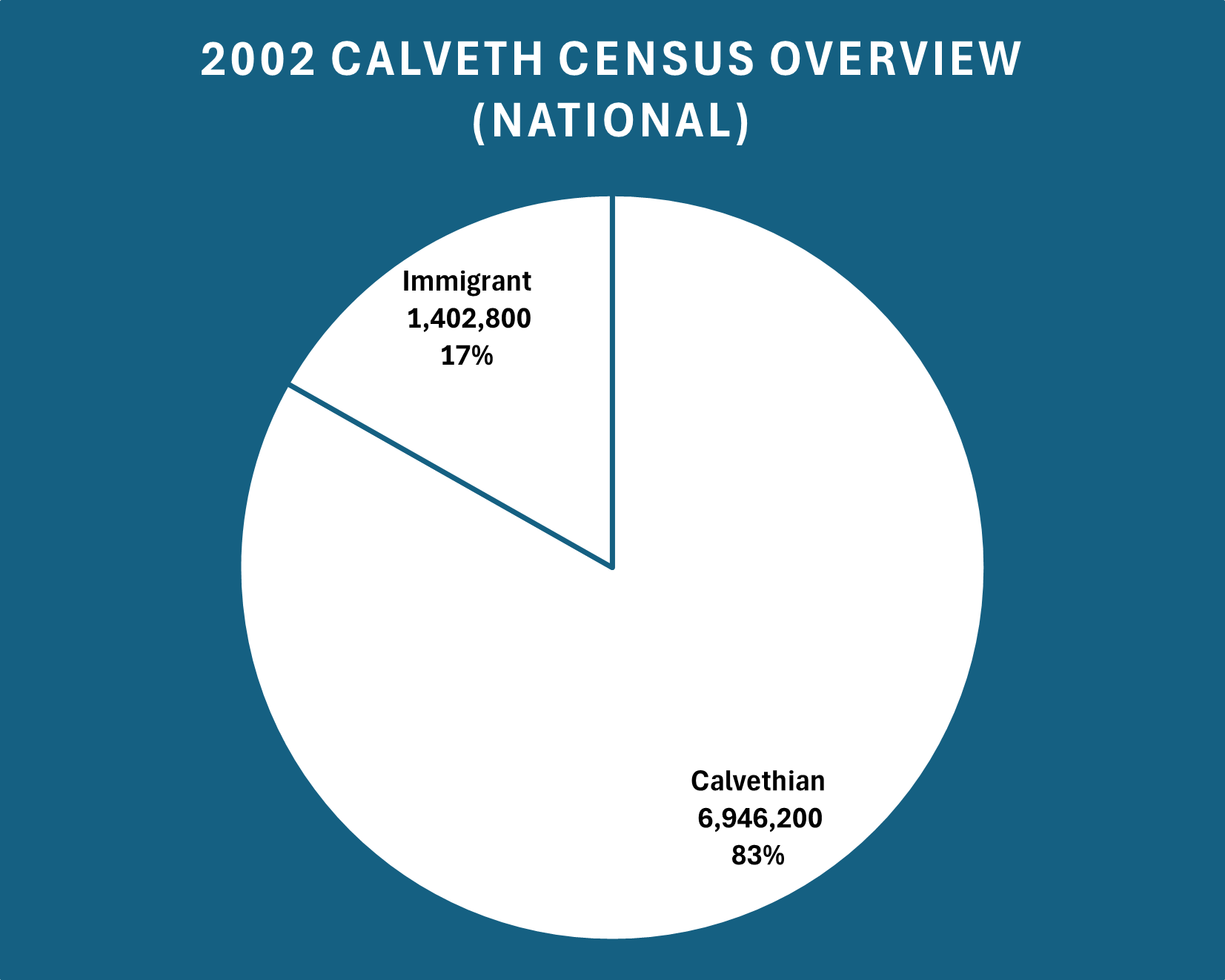
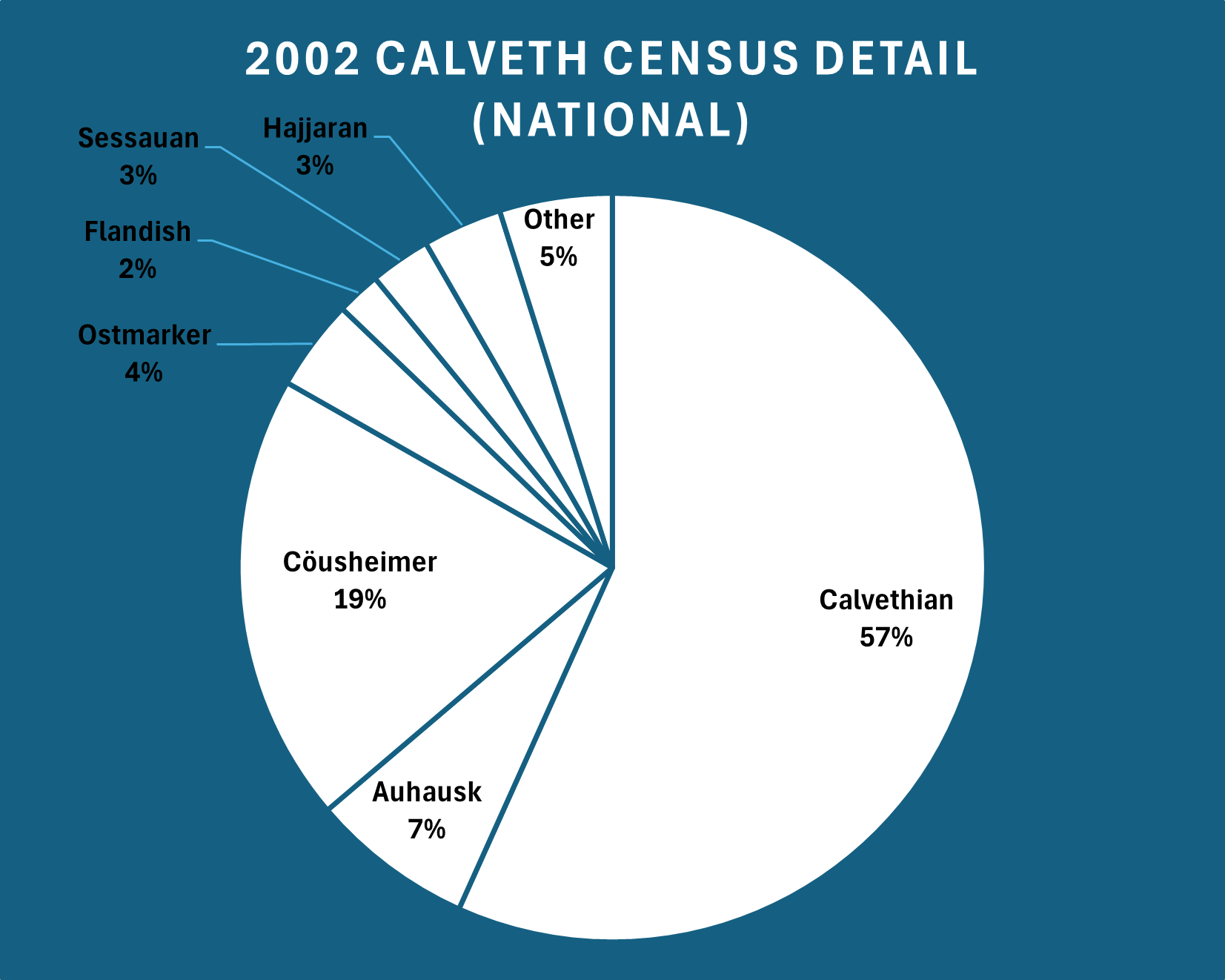
Calveth's population of approximately 8.3 million is relatively homogeneous by Meridian standards, reflecting the nation's geographic position and historically modest immigration. The core Calvethian population — descended from various seafaring tribes from the northeast who inhabited the territory before the kingdom's foundation, and for statistical purposes typically also encompassing the Cöusheimer subculture — constitutes approximately 76% of the population, with regional variation in dialect and cultural practice that the Landskomme system accommodates and the national culture celebrates.The ethnically distinct Auhausk, concentrated on Auhauskan Island (Calveth's largest island to the west of the mainland), comprise 7% of the population.
The immigrant population represent the remaining 17%, and has grown significantly since the 1970s, consisting primarily of communities from Sessau, Ostmark, Flandia and, increasingly, from Hajjara and other more distant countries. Calveth's economic performance and quality of public services have made it an attractive destination for both skilled professionals and asylum seekers, generating the same integration debates that characterize most wealthy Meridian nations, though the specific Calvethian context — strong institutions, genuine economic opportunity, a culture of pragmatic accommodation — has produced somewhat less acute social tension than comparable debates elsewhere.
Calvethian is the official language — a North Germanic-adjacent language with its own distinct literary tradition dating to the thirteenth century. Regional dialects vary considerably across the four Landskommes, with the Borastadt island dialects and the Auplandet northwest dialect most distinct from the standard Kolvanstaad-based written form. Meridian Common functions as the language of international commerce and is widely spoken among the educated population.
The population is aging — median age is 72 years on the nation's internal scale, reflecting low birth rates that have characterized Calveth since the 1970s. Immigration has moderated but not reversed this trend. The pension system remains structurally sound for now but the demographic mathematics of a shrinking working-age population supporting a growing retired population are a persistent subject of actuarial concern.
Culture
Calvethian culture reflects the accumulated character of a maritime northern nation that has been prosperous and stable long enough to develop considerable depth across the arts, sciences, and civic life. The literary tradition is old and distinguished — the Calvethian sagas of the twelfth and thirteenth centuries are among the most significant medieval literary documents in Meridian, and the modern novel has produced several writers of international reputation. Calvethian architecture ranges from the medieval timber-and-stone buildings of the oldest parts of Kolvanstaad and Trowheim to the functionalist modernism of the twentieth century welfare state's school, hospital, and housing programs — a tradition that prioritizes quality of construction, human scale, and longevity over spectacle.
Music occupies a significant place in Calvethian cultural life — both the classical tradition maintained by the Kolvanstaad Philharmonic, one of Meridian's major orchestras, and the folk tradition of the island communities, whose vocal harmonics and particular relationship to the sea have influenced Calvethian popular music in ways that give it a distinctive texture. The design tradition — furniture, domestic objects, graphic arts — is internationally recognized for the combination of functional clarity and material quality that has been described as the Calvethian aesthetic since the 1950s.
Sports culture is dominated by football (specifically Vola) at the club level, with community teams typically associated with the Liga Føderal and professional teams playing in Liga Calveth. The island communities maintain strong traditions of rowing competition that date to the pre-kingdom period, especially in the Aupland Isles and among the Auhausk. Calveth's national Vola team is considered one of the more competitive in Meridian, though not quite on-par with Crucera, owing in part to their relatively long history with the spot after adopting it from their own colonial territories. The national Vola landscape is characterized by a three-league professional system with promotion and relegation, as well as a semi-professional secondary system comprised on local teams which allows a single team to break into (or fall out of) the lowest league of the professional system each year
The relationship to the sea permeates Calvethian culture in ways that are not merely historical. Fishing remains economically significant in Auplandet and Borastadt. Sailing is the dominant leisure activity across all four Landskommes. The maritime heritage is genuinely alive rather than preserved in museums — though the museums are also excellent.
Foreign Relations
Calveth punches significantly above its demographic weight in international affairs, a consequence of its financial influence, its institutional credibility, and its strategic position as a stable, wealthy, and diplomatically active small state in northern Meridian. The foreign policy tradition is built on several consistent principles: support for multilateral institutions and international law, preference for diplomatic over military solutions, active development assistance to poorer nations as both moral commitment and strategic investment, and the maintenance of cordial relations with all major powers without formal military alliance with any.
The relationship with Ostmark is the most important bilateral relationship — the shared border, the deep economic integration, the cultural overlap in the Cöusheim borderlands, and the long history of both conflict and cooperation make this relationship the unavoidable foundation of Calvethian foreign policy. The relationship is currently excellent and has been for forty years, which represents a genuinely remarkable improvement over a pre-twentieth century history that included three wars.
Relations with Sessau are significant — Calveth and Sessau share a colonial history in Crucera whose legacies generate periodic diplomatic friction, and their economic models are different enough to create genuine policy disagreement within Meridian institutions. The relationship is functional and occasionally warm without being close.
The Crucera relationship is Calveth's most morally complex foreign policy domain. As the former colonial power in Melizea and several other Crucera territories, Calveth maintains commercial relationships, development aid programs, and cultural connections with former colonies whose populations sometimes receive these with justified ambivalence. The Calvethian government has been more willing than most former colonial powers to formally acknowledge the negative aspects of its colonial history, though civil society organizations in both Calveth and Crucera argue that acknowledgment without reparation is insufficient.
Military
The Calvethian Defence Forces are small relative to GDP but highly capable, reflecting the nation's wealth, its advanced technology sector, and a professional military tradition that emphasizes quality over quantity. The navy is the senior service by tradition and capability — a small fleet of modern frigates and patrol vessels, an effective submarine arm, and the maritime patrol capacity appropriate to a nation with significant offshore energy infrastructure and extensive island territories to protect. The army is structured for territorial defence and international peacekeeping rather than offensive operations. Calveth contributes consistently to international peacekeeping operations, regarding this as both a moral obligation and a component of the diplomatic standing that small states must actively maintain.
Military expenditure is modest as a percentage of GDP — Calveth has never been a significant military power and has maintained its security through alliance relationships, diplomatic investment, and the geographic good fortune of not sharing a border with any currently hostile power. The military is respected institutionally, apolitical, and not a significant factor in domestic politics.
Cities
Kolvanstaad (Folenberg, pop. 1,820,000) is the national capital and the commercial, financial, and political heart of Calveth. Home to the Kongresønde, the Royal Palace, and the headquarters of the nation's principal banks and professional services firms, Kolvanstaad is simultaneously an ancient city — its oldest districts preserve medieval timber-frame architecture along the original harbor waterfront — and a thoroughly modern one, its financial district among the most sophisticated in northern Meridia.
Trowheim (Borastadt, pop. 420,000) is Calveth's second city and its most important island settlement, situated on Felke Island's deep natural harbor. Historically the nation's second port after Kolvanstaad, Trowheim retains a strong maritime character and a fierce local pride that occasionally tips into rivalry with the capital. The city's distinct island culture — more informal, more weather-hardened, more attached to the sea as a working reality rather than a scenic backdrop — is a point of considerable self-congratulation among its residents.
Sondvig (Folenberg, pop. 348,000) is a coastal manufacturing and university city in northern Folenberg, its economy built around precision engineering industries and the academic community of Sondvig University, one of Calveth's older institutions of higher learning. The combination of industrial and academic culture gives Sondvig a particular energy — practical and intellectual simultaneously — that distinguishes it from the purely commercial cities of the south.
Dinsåg (Cöusheim, pop. 310,000) sits on the southwest bay of the Cöusheim coast and is the most culturally distinctive city in Calveth, its centuries of proximity to Ostmark having produced an architecture, a cuisine, and a local dialect that blend Calvethian and Ostmark influences into something recognizably neither. Dinsåg is the natural hub of cross-border commerce and the city where Calvethians most comfortably acknowledge that their southern neighbor has been a formative influence.
Vesfjord (Folenberg, pop. 228,000) sits on the northern edge of Folenberg and serves as the primary ferry hub connecting the northeastern island chain to the mainland. Its identity is defined by transit — boats arriving and departing, islanders passing through, goods moving in both directions — giving it a cosmopolitan energy somewhat surprising for its latitude and size. The ferry terminal is the largest structure in the city and operates around the clock regardless of weather.
Gøsmund (Auplandet, pop. 180,000) sits at the head of the largest fjord inlet on the northwestern peninsula and functions as the regional capital of Calveth's most geographically dramatic Landskomme. A fishing and maritime services hub since the pre-kingdom period, Gøsmund has the character of a city that has always looked outward to the sea rather than inward to the mainland, its waterfront lined with working boats alongside the regional government buildings and a university known for its marine science faculty.
Morstaad (Borastadt, pop. 107,000) is the principal settlement on Auhauskaan Island, the larger of the two Borastadt islands, whose interior upland terrain has historically supported extensive sheep farming and the self-sufficient culture of communities that managed long winters with limited mainland contact. Like the rest of Auhauskaan Island, Morstaad is uniquely culturally Auhausk, though with more Calvethian cultural influence than the island's surrounding rural areas.
Temdornet (Cöusheim, pop. 94,000) is an agricultural market town on the southern plains of Cöusheim, its economy organized around the processing and distribution of the region's considerable farming output. Temdornet has the unhurried character of a place whose function is clear and whose residents have been performing it for several centuries without significant interruption. The weekly market remains the social center of town in a way that has largely disappeared from more urbanized Calvethian cities.
Wilmonstaad (Cöusheim, pop. 82,000) is a border trade community in the southern reaches of Cöusheim, its mixed Calvethian and Ostmark heritage visible in the street names, the architecture, and the menus of its restaurants. Wilmonstaad exists because the border passes through a commercially convenient river crossing, and it has been making practical use of that geography for the better part of eight hundred years.
Vosje (Auplandet, pop. 64,000) is a fishing community on the northwestern peninsula whose economy and culture have changed less in the past century than almost any comparable Calvethian settlement. The exposed coastline that makes Vosje's location challenging is also the source of some of the richest fishing grounds in northern Meridia, and the community's relationship to those grounds — practical, respectful, and entirely unsentimental — defines its character.
Lauhaagen (Borastadt, pop. 58,000) on Felke Island is the center of Calveth's traditional boat building industry, its workshops and dry docks producing everything from working fishing vessels to the high-end sailing craft that Calvethian leisure culture demands in considerable quantity. The craft tradition here is old enough that apprenticeship structures and family dynasties of builders still operate alongside the more modern commercial yards.
Korving (Auplandet, pop. 44,000) is the northernmost significant settlement in Calveth, positioned on the outermost of the northeastern island chain and exposed to weather that makes Kolvanstaad's winters seem temperate. Korving's existence is a function of the fishing grounds that surround it and the strategic position it has historically provided — the islands here were fortified during the medieval period and the old defensive works are the town's principal tourist attraction.